If you’re running a fleet or managing a business that depends on transport, you don’t need a data release to tell you that fuel costs are biting. But new figures from the Australian Bureau of Statistics put a number to it: 72 per cent of Australian businesses have been negatively impacted by fuel prices and supply availability.
The May 2026 Business Conditions and Sentiments survey confirms what’s been driving the pressure. Fuel costs have risen off the back of global volatility, and the partial closure of the Strait of Hormuz has had a direct downstream effect on Australian operating expenses. One in six businesses has already experienced supply chain disruptions as a result, with transport, logistics, agriculture, and small business bearing the sharpest impact.
Half of all businesses reported that operating expenses had risen, with fuel prices and freight costs cited most frequently. When you break it down by sector, the picture is stark:
| Industry | Impacted by Fuel Prices (%) | Impacted by Freight/Delivery Costs (%) |
| Electricity, gas, water and waste services | 97 | 66 |
| Transport, postal and warehousing | 95 | 37 |
| Agriculture, forestry and fishing | 94 | 85 |
| Manufacturing | 94 | 78 |
| Construction | 86 | 56 |
| Retail trade | 86 | 73 |
Source: Australian Bureau of Statistics, May 2026
The businesses reaching out to us lately reflect exactly that spread. Trade companies, courier operators, regional service businesses, and small fleets that have simply reached the point where reimbursing fuel receipts no longer makes sense. They’re all feeling fuel costs differently, but they’re asking remarkably similar questions about where they can reduce waste without making life harder for their drivers.
How Businesses Are Responding (And Why Most Approaches Are Defensive)
About 60 per cent of Australian businesses have already made operational changes in response to fuel prices or supply issues. The breakdown looks like this:
- 48% are absorbing the increases into their margins
- 28% have reduced workforce or travel, including 15% cutting non-essential travel and 9% cutting staff
- 11% are passing costs on to customers
Absorbing costs works until it doesn’t. Passing them to customers risks pricing you out of a market that’s already tight. Cutting travel or staff reduces capacity. All three of these are positions that shrink the business rather than protect it, and none of them address the underlying problem.
The more effective move is to look at how you’re actually buying fuel, and whether you’re doing it in the most cost-effective way possible.
Why a Fuel Card Strategy Makes Sense Right Now
If your team is still reimbursing paper receipts or running fuel through a general corporate card, you’re leaving savings on the table and taking on unnecessary exposure. A dedicated fuel card changes both of those things.
For many of the businesses we’ve helped compare fuel cards, the goal isn’t just saving a few cents per litre. It’s replacing dozens of receipts each month, giving office staff one invoice instead of fifty, and making it easier to see exactly what each vehicle is costing to run.
In practical terms, here’s what a good fuel card delivers:
- Cents-per-litre discounts at the pump. In a volatile pricing environment, a fixed discount provides a real buffer against market spikes, not just on good weeks but every single fill.
- Consolidated invoicing. Every fuel purchase appears on a single ATO-compliant invoice. Most cards integrate directly with Xero and MYOB, which removes a meaningful chunk of admin from your finance team’s workload.
- Spend controls by driver, vehicle, or time. Cards can be restricted to fuel-only purchases, or set with spending limits and time-of-use restrictions. That reduces the risk of misuse and removes the need to audit every transaction after the fact.
- Improved cash flow. Many fuel cards offer interest-free credit periods, which lets you align fuel expenses with your billing cycles rather than absorbing them on irregular intervals.
The Fuel Cards Worth Looking At Right Now
No two fleets are exactly the same. A business running two vehicles around Melbourne CBD has very different priorities from a transport company operating across regional Queensland. The best option usually comes down to where your drivers fill up, how your accounts team manages expenses, and whether you value bigger fuel discounts or broader network coverage.
Based on what we’re seeing right now, these are the three cards worth a close look.
Shell Card
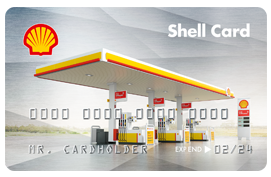
I recommended the Shell Card to plenty of businesses with fairly predictable metro routes, including plumbing, electrical, and HVAC companies whose teams are already stopping at Shell or Reddy Express locations most days. In those situations, the network already fits how the business operates, so changing payment methods is much easier than changing driver behaviour.
The card is accepted at over 1,600 locations nationally, covering Shell, Reddy Express, OTR, Liberty, and Westside stations. New customers currently get 7c/L off fuel for the first six months using the promo code CPM7FOR6, dropping to a fixed 2c/L on unleaded and 4c/L on premium after that. The monthly card fee is $2.50, waived entirely for the first six months, and there are no transaction fees at participating stations.
It integrates with both Xero and MYOB. For small to medium businesses with predictable routes and drivers who are already Shell-adjacent, this is one of the stronger options on the market.
Save 7c/l + $0 card fees in promo period
FleetCard Classic
FleetCard is the card I discuss with businesses once they have several vehicles travelling in different directions every day. Landscaping companies, property maintenance businesses, and regional sales teams regularly tell me that broad network coverage is more valuable than asking every driver to stick to a single fuel brand.
FleetCard Classic is accepted at over 6,100 fuel stations nationally, which covers around 90 per cent of sites across Australia, including BP, Shell, 7-Eleven, Ampol, and Mobil. It’s also accepted at over 6,000 non-fuel merchants for servicing, tyres, windscreens, and repairs, so it consolidates a broader slice of vehicle running costs onto one bill.
New customers currently get 6c/L at Shell and Reddy Express, and 3c/L at 7-Eleven and Ampol for the first six months. The monthly card fee is $2.99 for the first six months, then $5.99 ongoing. For fleets of three to 20 vehicles that can’t rely on being near a specific station brand, the coverage makes this card worth a look.
Save up to 6c per litre on fuel for your business

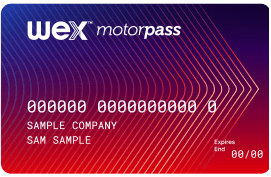
Wex Motorpass
Regional businesses are often the ones who appreciate WEX Motorpass the most. I’ve spoken with operators whose drivers might fill up at a major service station one day and an independent site the next, so having broad acceptance across Australia becomes a practical advantage rather than just a line on a brochure.
WEX Motorpass is accepted at over 6,500 service stations, covering around 90 per cent of sites nationally, including BP, Ampol, Shell, 7-Eleven, United, and a significant number of independents that other cards don’t reach. Beyond fuel, it covers tyres, batteries, servicing, car washes, parking, and accommodation. The reporting is solid: ATO-compliant statements capture transaction-level detail including vehicle ID, driver ID, and odometer readings, and data exports into most accounting systems without much friction.
Worth noting: there’s a $0.75 transaction fee per purchase (and a 2% surcharge at Coles Express locations), so it’s not the best fit for very high-frequency, low-volume fills. The monthly fee is $5.99 per card, currently waived for six months for new customers using the promo code ZEROFEE26.
$0 card fees
BP Plus
BP Plus comes up often with businesses that are already Qantas loyalists or whose drivers are frequently on major freight corridors. BP has the largest single-brand truck-friendly network in Australia, with over 500 dedicated truck stops across the country, which matters a lot if you’re running heavier vehicles on long-haul routes between capital cities.
The card is accepted at over 1,400 BP service stations nationally and extends to Wild Bean Cafes and BP carwash facilities. There’s also EV charging access through the bp pulse network at over 250 rapid and ultrafast charge points, which is worth knowing if your fleet is mixed or you’re planning ahead for electrification.
On discounts, new customers currently get 8c/L off eligible fuel for the first six months, plus up to 100,000 bonus Qantas Points and 3x Qantas Points on eligible fuel in that same period. The ongoing discount drops back to a standard rate after the promo window. Monthly card fees are $2.95 per card for businesses holding three or more cards, or $4.95 for smaller accounts. There are no transaction fees, which is a genuine plus for high-frequency fill-ups. Interest-free terms are 21 days, shorter than some competitors, so it’s worth factoring that into your cash flow planning.
AmpolCard
AmpolCard is the one I tend to discuss with diesel-heavy fleets that are already running through Ampol sites regularly. It’s accepted at approximately 1,800 locations across Australia, including Foodary outlets and EG Ampol sites, and it covers both metro and regional areas reasonably well. For transport and logistics operators whose drivers are already familiar with the network, there’s not a lot of behaviour change required.
The ongoing discount structure is 4c/L on Amplify Premium petrol, 3c/L on Amplify Premium diesel, and 2c/L on regular petrol and diesel. Right now, new customers applying before 31 August 2026 can choose between three promotional offers: 8c/L off for 10 months (promo code 26AC8FOR10), 6c/L off for 18 months (26AC6FOR18), or 6c/L off for six months plus up to 100,000 Everyday Rewards points (26AC6FOR6EDR). The 18-month option in particular stands out for businesses that want a longer runway on their introductory savings rather than a sharp drop-off.
The monthly card fee is $2.95 per vehicle, which is one of the lower fees on the market. Everyday Rewards integration lets you earn points on every litre, redeemable at Woolworths or convertible to Qantas Points. Optional add-ons include roadside assistance ($5.25/month per vehicle) and a services and repairs network of over 5,000 locations ($2.00/month per vehicle), including Bob Jane T-Marts and O’Brien.
Find the Right Fuel Card for Your Fleet
The businesses we help aren’t all the same. Some are running five utes around metro Melbourne. Others have drivers covering regional Queensland in different directions every day. The card that works for one won’t always work for the other, and the wrong choice usually means paying more than you need to or creating headaches for your admin team.
Answer a few quick questions about your fleet, your routes, and how you currently manage fuel expenses, and we’ll point you to the card that actually fits your business, not just the one with the biggest number in the headline.
|